
Crackingstone
Uranium/Rare Earths
Crackingstone Uranium + Rare Earth Elements (U–REE)
Modern re-assaying confirms uranium mineralization and identifies REE-enriched pegmatite intervals—supporting a structurally focused critical-minerals exploration model.
Feb 3, 2026 – Re-Assay Results (Uranium + REEs)
Belmont completed modern re-assaying of selected 2008 drill core intervals to (i) re-analyze uranium intervals using current methods and (ii) test pegmatite-hosted intervals that were not assayed for REEs in 2008. The results identified multiple intervals with elevated uranium and rare earth elements, including zones of coincident U + REE enrichment, supporting Crackingstone’s potential as an integrated U–REE critical minerals system.
Re-assay highlights (summary)
-
Multiple re-assayed intervals with elevated uranium values
-
REE-enriched pegmatite-hosted intervals identified where REEs were not previously assayed
-
Several zones show coincident uranium and REE enrichment
Analytical & Cautionary Notes
Re-assay samples were analyzed by an accredited laboratory using ICP-MS following total digestion for uranium and rare earth elements. Uranium is reported in ppm and total REEs (ΣREE) represent the sum of measured REEs (La–Lu plus Y), reported in ppm. A calculated U×ΣREE value is a non-standard internal comparison metric only and does not represent grade or economic significance. Reported intervals are individual sample results and should not be interpreted as average grades or evidence of economic mineralization.
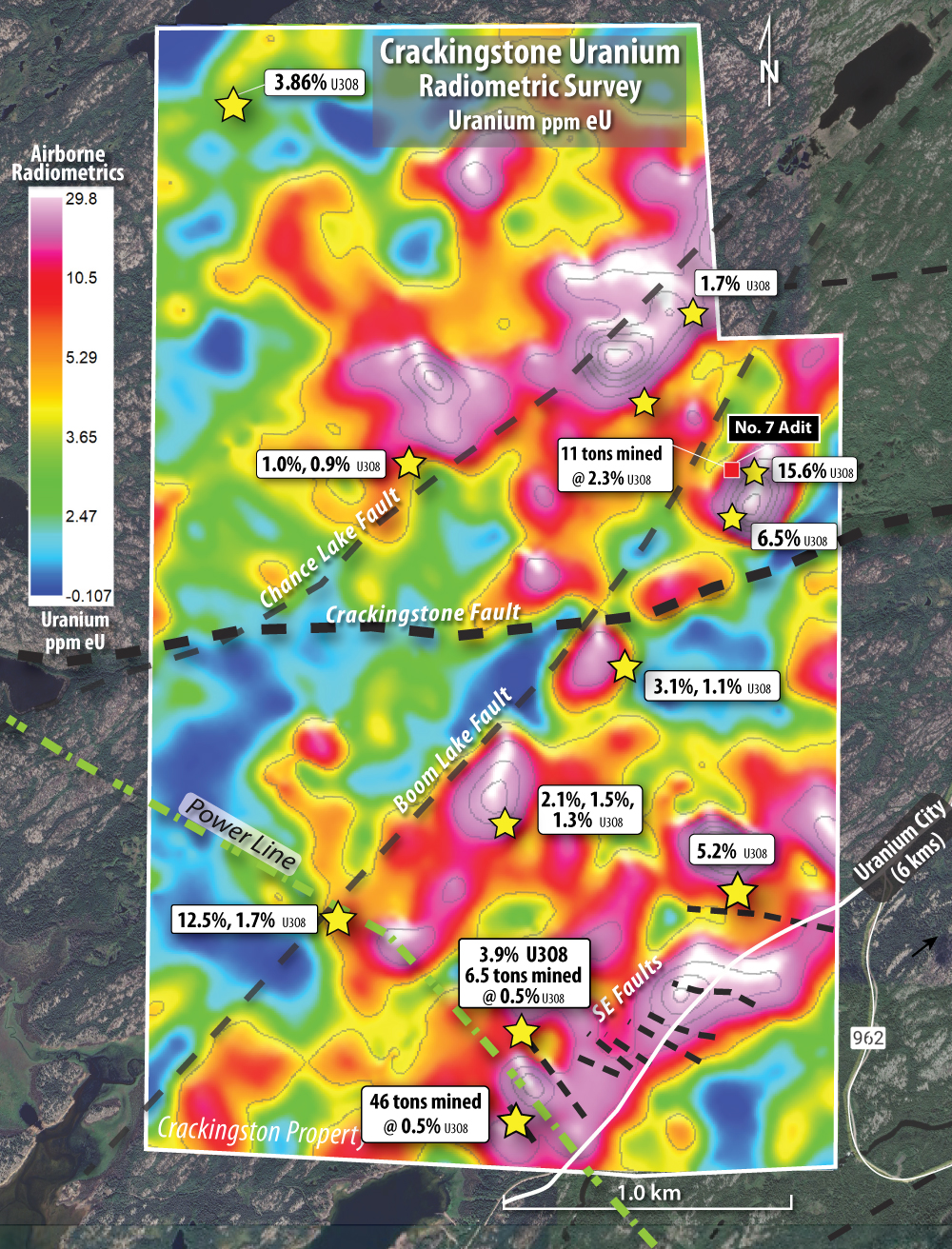
Airborne uranium radiometrics define two broad uranium domains and fault-controlled corridors within the Black Bay Shear Zone framework.
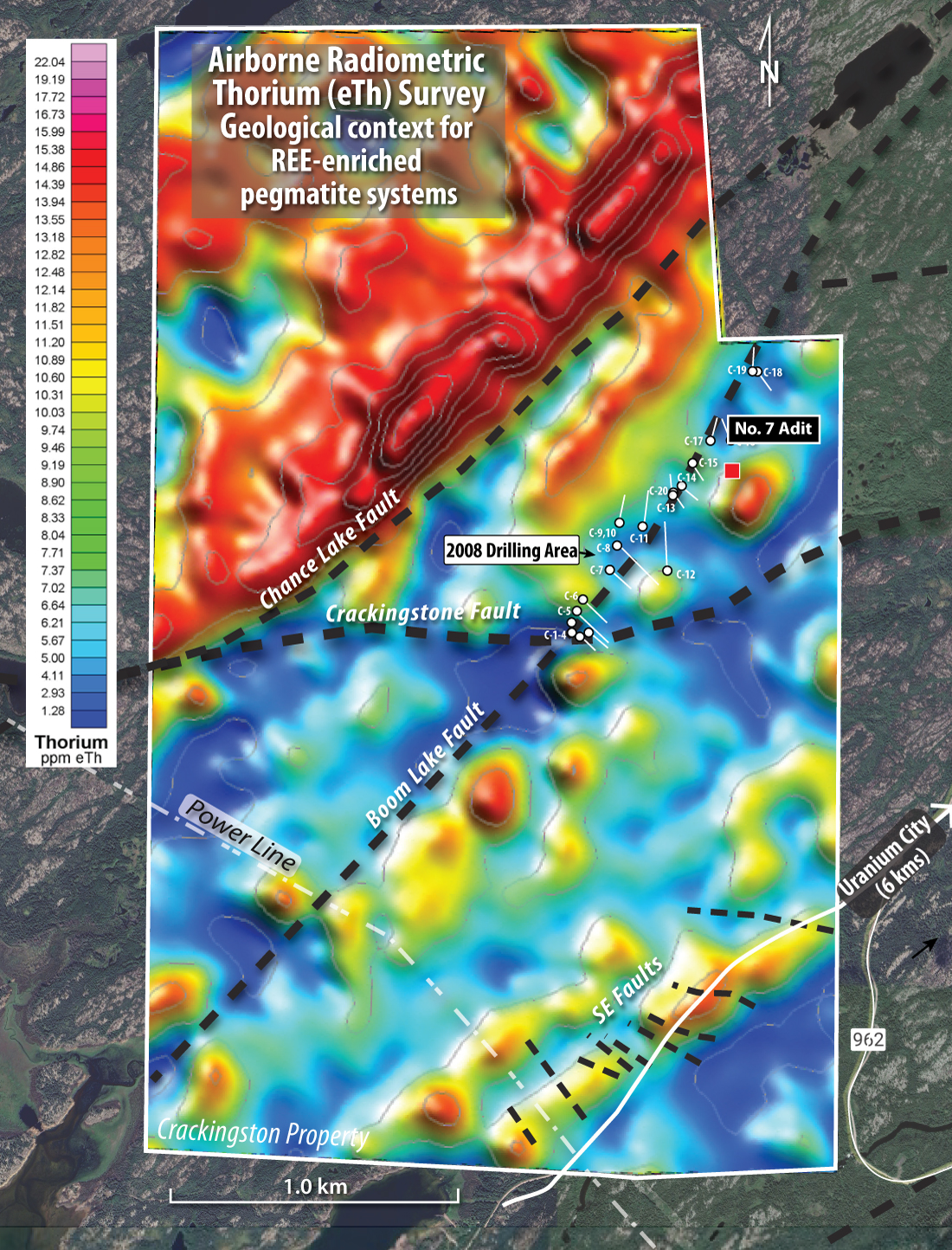
Airborne thorium radiometrics highlight structurally aligned, evolved corridors used as geological context for REE-enriched pegmatite potential; radiometrics are not indicative of mineral grades.
Crackingstone’s Structural Framework
Uranium mineralization at Crackingstone is controlled by a fault-dominated structural framework developed along the Black Bay Shear Zone. Airborne radiometric data define two broad uranium domains, north and south, separated by the Crackingstone Fault, reflecting first-order segmentation of the mineralized system.
Within these domains, uranium mineralization is further localized along discrete fault-controlled corridors, including the Chance Lake, Boom Lake, and southeastern fault trends. These structures acted as primary pathways for mineralizing fluids and also host pegmatites that introduce potential rare earth element upside, contributing to Crackingstone’s distinctive exploration profile within the Beaverlodge camp.
The Uranium Exploration Thesis
The airborne uranium radiometric data highlight a strong, structurally controlled uranium response extending along the Black Bay Shear Zone across the Crackingstone property. Two broad uranium domains are evident, separated by the Crackingstone Fault, with elevated uranium values focused along fault-controlled structural corridors.
Clusters of high radiometric response coincide with historic uranium showings, underground workings, and drill intercepts, confirming that the airborne anomalies reflect real uranium mineralization. The continuity and intensity of the uranium response support the interpretation of a large, fertile uranium system, defining multiple priority targets for follow-up exploration and drilling.
Structurally controlled uranium radiometric anomalies define two uranium domains at Crackingstone.
The Rare Earths Exploration Thesis
Rare earth element potential at Crackingstone is linked to large-scale thorium anomalies, pegmatite development, and the same fault-controlled structural corridors that localize uranium mineralization. A prominent, property-scale thorium anomaly associated with the Chance Lake Fault highlights a long-lived corridor characterized by evolved lithologies and incompatible element enrichment—an environment commonly associated with REE-fertile systems.
Importantly, Belmont’s modern re-assaying has now confirmed that several previously untested pegmatite-hosted intervals contain meaningful REE enrichment, and in some cases coincident uranium and REE values, strengthening the dual-commodity exploration model.
A large, structurally controlled thorium anomaly along the Chance Lake Fault highlights a long-lived, evolved geological corridor that provides strong vectoring for rare earth element potential within the Crackingstone structural framework.
Electromagnetic (EM) Conductors and Structural Controls
Airborne electromagnetic surveys at Crackingstone have outlined multiple conductive trends aligned with major shear zones and structural corridors. These conductors are interpreted to reflect graphitic horizons, sulphide-bearing fault zones, or conductive alteration, features commonly associated with uranium mineralization in the Beaverlodge district.
The strong spatial association between EM conductors, uranium–thorium radiometric anomalies, and known surface showings supports the interpretation of a fertile, structurally controlled uranium system, helping to refine priority targets for follow-up exploration.
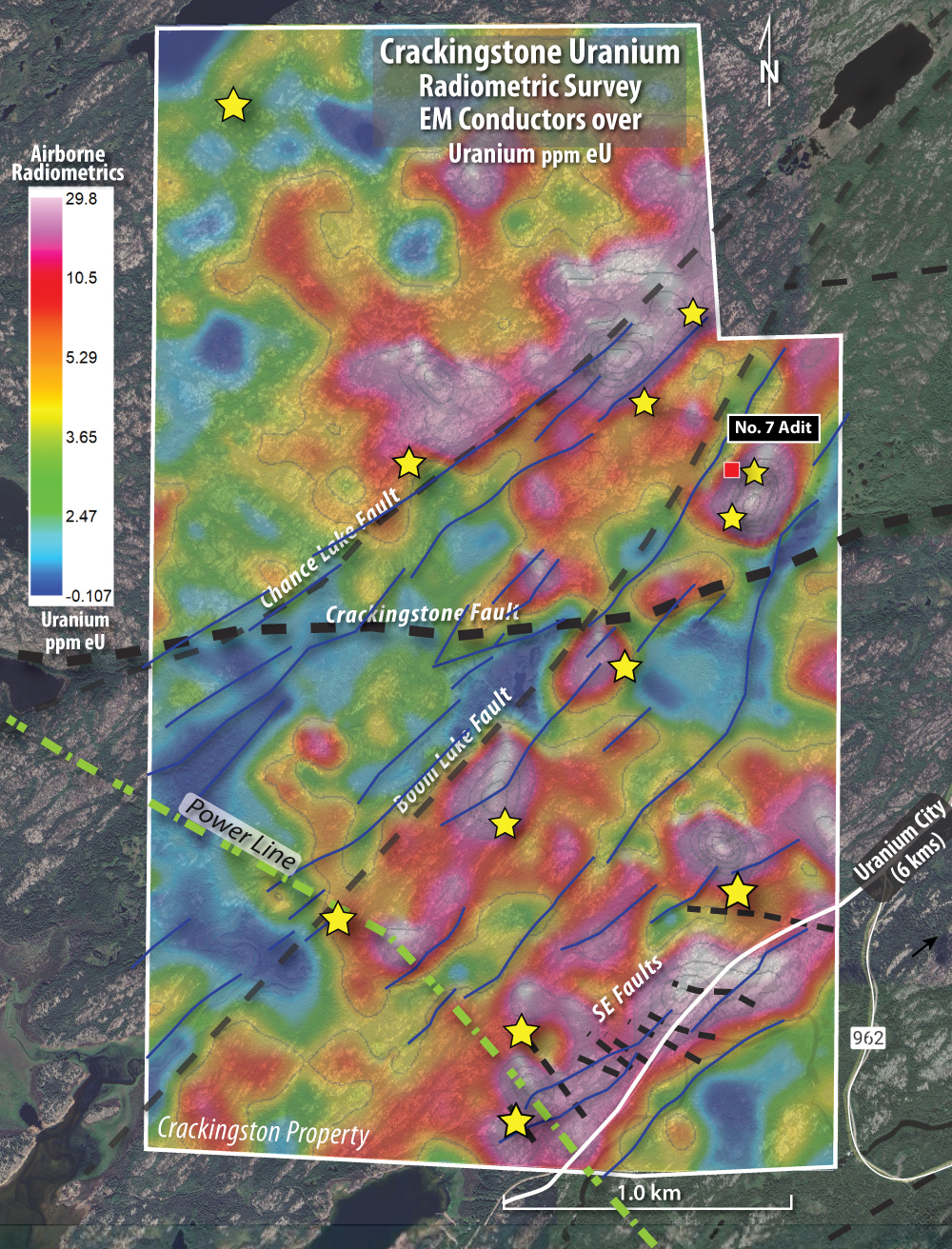
EM conductors coincide with radiometric anomalies and structural corridors.
Integrated Geophysical Interpretation
Integrated interpretation of uranium, thorium, potassium radiometrics and airborne electromagnetic data at Crackingstone defines a large, structurally controlled mineral system developed within the Black Bay Shear Zone. Uranium radiometrics delineate two broad uranium domains separated by the Crackingstone Fault, establishing the primary framework for mineralization. Thorium anomalies highlight evolved lithological environments and long-lived structural corridors, providing geological vectoring for potential rare earth element enrichment. Potassium responses reflect hydrothermal alteration and lithological variation aligned with major structures, supporting continuity of the mineral system. Airborne EM conductors further define structurally focused conductive zones interpreted to represent graphitic horizons, sulphide-bearing structures, or conductive alteration. Together, these complementary datasets reinforce interpretation of a fertile, multi-episode mineral system and provide a coherent framework for refining priority drill targets across the Crackingstone project.
2008 Drill Program
-
The 2008 drill program provides a strong technical foundation for renewed exploration at Crackingstone and offers important insights into the controls and distribution of uranium mineralization across the property.
-
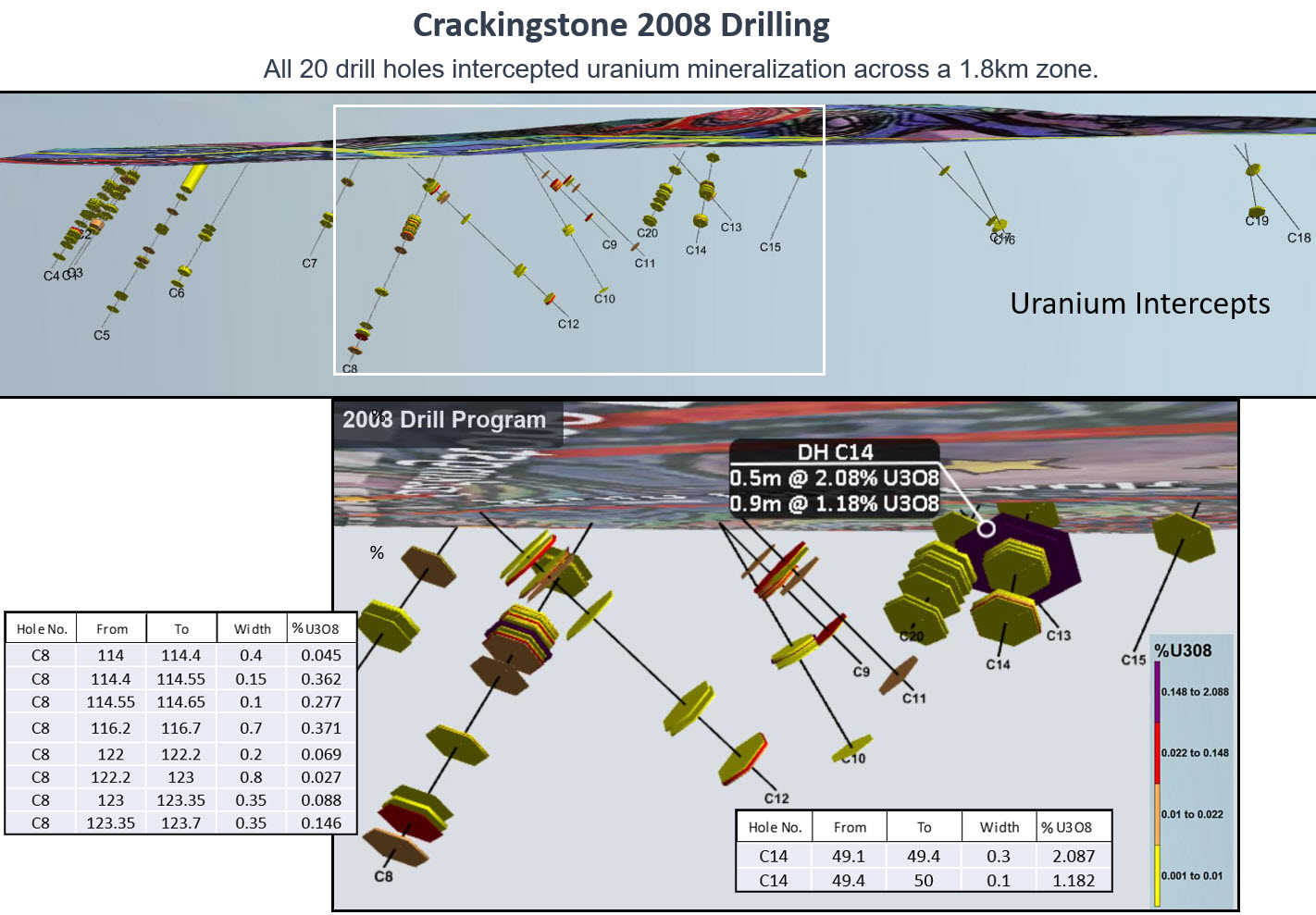
Widespread Uranium Intersections: Uranium mineralization was intersected in all 20 drill holes, confirming a pervasive uranium-bearing system rather than isolated showings. This validates the effectiveness of the structural and radiometric targeting approach.
-
High-Grade Intervals: The program returned several notable high-grade intercepts, including 2.09% U₃O₈ over 0.3 m within a broader interval of 1.18% U₃O₈ over 0.9 m, demonstrating the presence of localized high-grade uranium concentrations within a broader mineralized system.
-
Structurally Controlled Mineralization: Drilling outlined an approximately 1.8 km mineralized trend associated with major fault structures, particularly along the Boom Lake and Crackingstone fault systems. Uranium mineralization is closely associated with structural corridors, brecciation, and alteration, rather than stratigraphic controls.
-
Alteration and Pegmatite Association: The program intersected thick pegmatitic intervals and widespread hematite alteration, features commonly associated with structurally controlled uranium systems in the Beaverlodge district. Many pegmatite intervals were not assayed for rare earth elements, representing an opportunity for re-evaluation.
-
Targeting Implications: The 2008 results confirm the importance of fault intersections and structural complexity in localizing uranium mineralization and provide a clear framework for follow-up drilling focused on high-priority structural targets within the broader uranium domains.
-
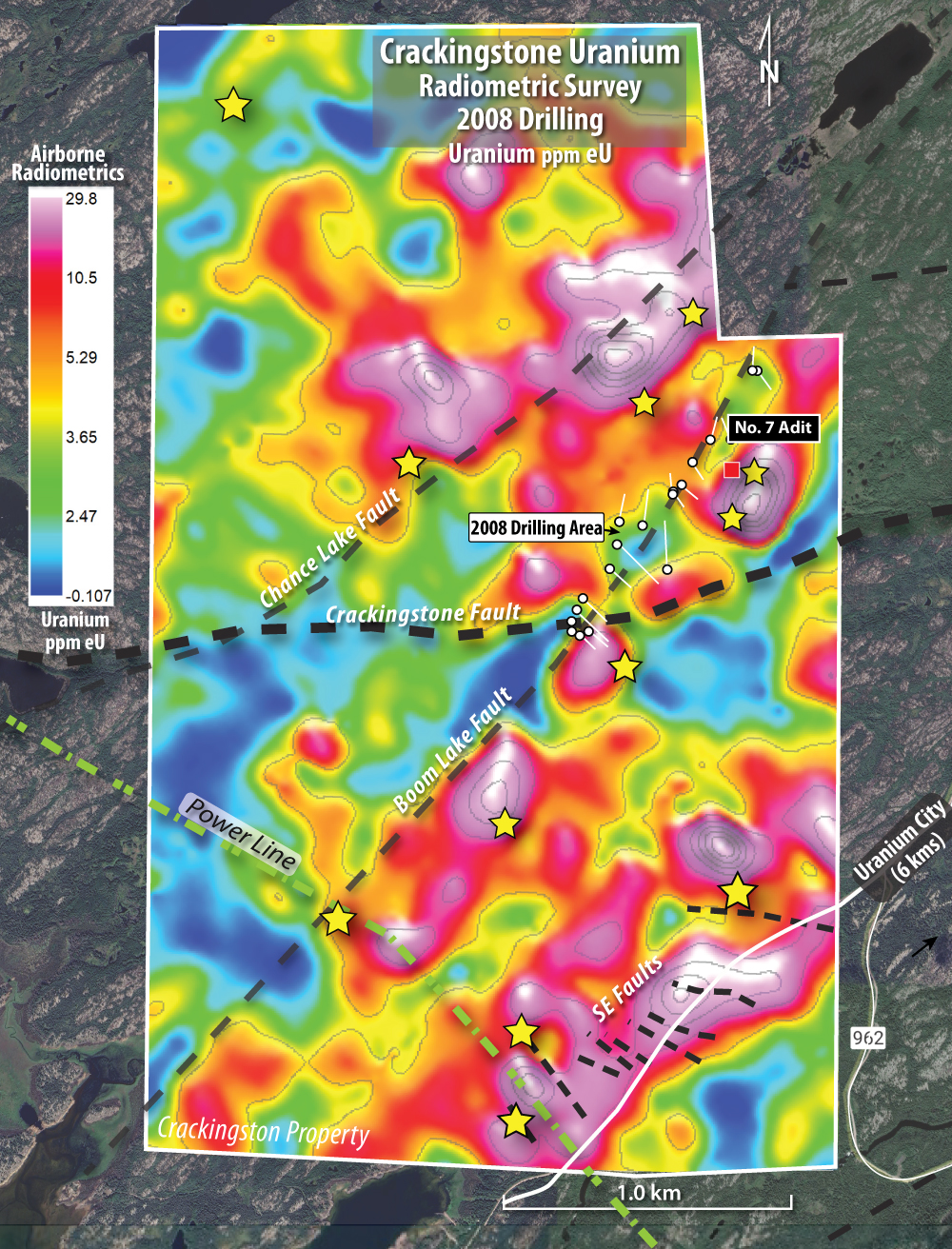
2008 drilling confirms uranium mineralization and structural control.
2008 Drill Sections
Crackingstone 2008 drill section – Uranium
Crackingstone 2008 drill section – Hematite

Crackingstone 2008 drill section – Pegmatite

Crackingstone 2008 Drill Sections – Uranium
The 2008 drill sections demonstrate that uranium mineralization was intersected across the drilled area, confirming a laterally continuous, structurally controlled uranium system rather than isolated point occurrences. Uranium intercepts occur at multiple depths and along key structural trends, supporting the interpretation of fault-focused uranium deposition within a broader mineralized framework.
Crackingstone 2008 Drill Sections – Hematite
Hematite alteration is widespread across the 2008 drill sections and shows a strong spatial association with uranium intercepts. This relationship indicates hydrothermal alteration linked to structurally controlled fluid flow, a common feature of uranium systems in the Beaverlodge district. The distribution of hematite supports its use as an important vector toward uranium mineralization, rather than a standalone target.
Crackingstone 2008 Drill Sections – Pegmatite
The drill sections highlight numerous thick pegmatite intersections within the mineralized structural corridors. These pegmatites are spatially associated with uranium mineralization and hematite alteration, suggesting emplacement along the same fault-controlled pathways. Many pegmatite intervals from the 2008 program were not assayed for rare earth elements, representing an opportunity for re-evaluation in the context of the project’s potential dual-commodity upside.
2008 Drill Summary
-
The 2008 drill program provides a strong technical foundation for renewed exploration at Crackingstone and offers important insight into the controls and distribution of uranium mineralization across the property.
-
Uranium mineralization was intersected in all 20 drill holes, confirming a pervasive, structurally controlled uranium system rather than isolated occurrences. Several high-grade intervals were encountered, including 2.09% U₃O₈ over 0.3 m within a broader interval of 1.18% U₃O₈ over 0.9 m, demonstrating the presence of localized high-grade mineralization within a broader system.
-
Drilling outlined an approximately 1.8 km mineralized trend associated with major fault structures, particularly the Boom Lake and Crackingstone faults. Thick pegmatite intervals and widespread hematite alteration were intersected, reinforcing the importance of structure and alteration as key vectors for future targeting.
Regional Context and Geological Significance


Crackingstone’s location within the Beaverlodge uranium district anchors the project in one of Canada’s most established and historically productive uranium camps. The district has a long record of uranium discovery and production, providing important geological context and a proven framework for structurally controlled uranium systems.
The Crackingstone property spans approximately 5 kilometres of the Black Bay Shear Zone, a major uranium-fertile structure that hosts multiple past-producing uranium mines. Between 1953 and 1982, the Beaverlodge camp produced over 70 million pounds of U₃O₈, underscoring the district’s world-class uranium endowment.
At Crackingstone, this regional setting translates directly into exploration relevance. The Black Bay Shear Zone provides the primary structural framework controlling uranium mineralization, linking historical production, favourable geology, and strong geophysical responses. Together, these factors reinforce Crackingstone’s high prospectivity for uranium discovery, while the presence of pegmatites introduces potential rare earth upside that distinguishes the project within the district.